QUESTION
Is write() an ordinary C function or a kernel entry point?
Applications normally call glibc's write(). The function loads its arguments into registers according to the architecture ABI and executes the syscall instruction. The kernel selects an implementation by syscall number and returns a negative errno value.
Treating the libc wrapper and the kernel syscall implementation as the same function leads you to debug in the wrong place. In userspace you see -1 and errno; at the kernel boundary you see a negative error code and the actual number of bytes returned.
STRUCTURE
Structure diagram
Userspace -1/errno and a negative kernel error code do not exist at the same point. The diagram shows what each layer passes to the layer below.
CALL PATH
Call path
A userspace function return value and a kernel-internal return value use different representations. Keep separate the point where libc converts a negative kernel error into -1 and errno.
This diagram is not for memorizing function names. Follow which return value, file descriptor, memory mapping, or wait queue is passed to the next stage.
SOURCE COORDINATES
Linux 6.18.37 LTS source locations
Go beyond the glibc function to the files where the syscall implementation meets kernel objects. Each link points to the original file at the same tag.
| File | Function / structure | What to inspect |
|---|---|---|
| arch/x86/entry/entry_64.S | entry_SYSCALL_64 | The first point where the CPU turns userspace registers into pt_regs |
| fs/read_write.c | ksys_write(), vfs_write() | How an integer fd becomes a struct file and file_operations |
| include/linux/syscalls.h | SYSCALL_DEFINE3(write) | The syscall prototype and argument types |
COMPLETE PROGRAM
Complete runnable example
The code below is not pseudocode with explanatory lines omitted. It is a minimal example that can be built and run as a file.
cc -std=c17 -Wall -Wextra -O2 syscall_write.c -o syscall_write01#include <errno.h>
02#include <stdio.h>
03#include <string.h>
04#include <unistd.h>
05
06int main(void)
07{
08 const char message[] = "syscall boundary\n";
09 size_t done = 0;
10
11 while (done < sizeof(message) - 1) {
12 ssize_t n = write(STDOUT_FILENO, message + done,
13 sizeof(message) - 1 - done);
14 if (n > 0) {
15 done += (size_t)n;
16 continue;
17 }
18 if (n < 0 && errno == EINTR)
19 continue;
20 fprintf(stderr, "write: %s\n", strerror(errno));
21 return 1;
22 }
23 return 0;
24}RUN RESULT
Run results
The example was run on x86_64 Linux.
Execution environment
On 2026-11-04 the program above was built and run unmodified on x86_64 Debian (Linux 6.12.94, gcc 14.2.0, glibc 2.41, -std=c17). This differs from the article baseline (ARM64, Linux 6.18.37 LTS), so PIDs, inodes, and addresses differ from run to run.
The write issued through the libc syscall wrapper prints as expected. The NASM example in the text also assembled, linked, and ran unchanged; strace shows write returning 16 bytes followed by exit(0).
$ ./syscall_write
syscall boundary
$ strace -e trace=write,exit ./hello_nasm   # lab: NASM example from this page
write(1, "hello from NASM\n", 16hello from NASM
)       = 16
exit(0)                                 = ?
+++ exited with 0 +++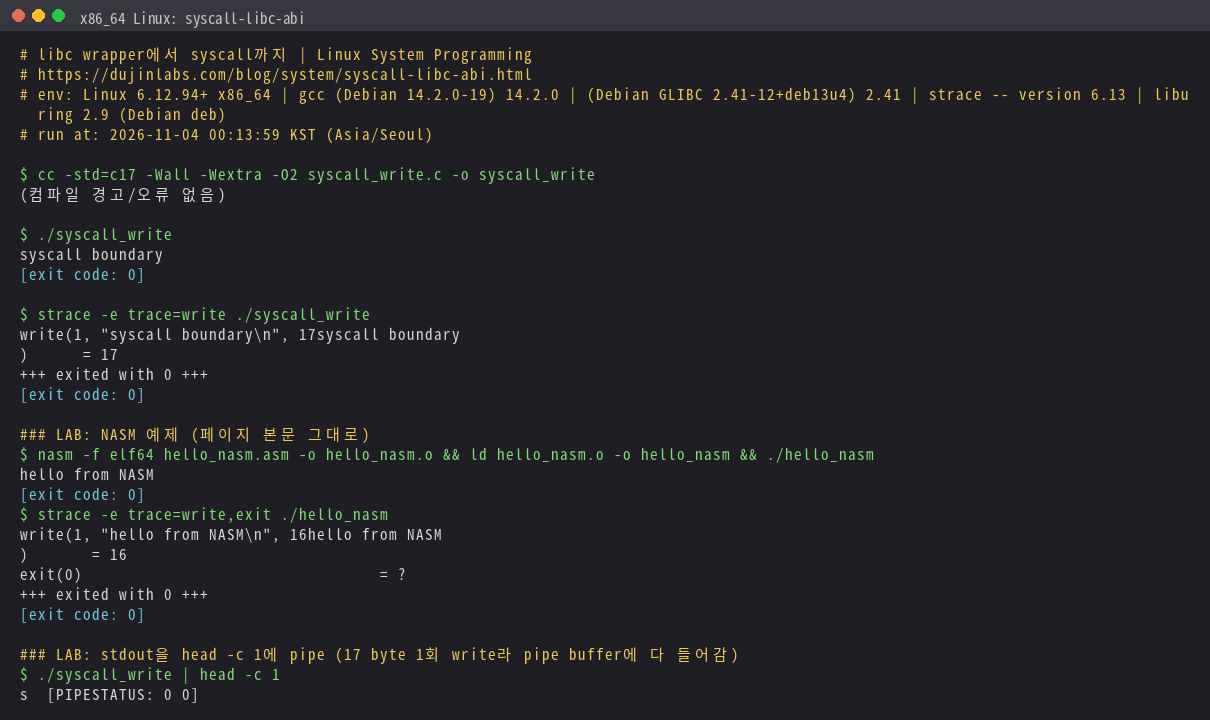
ARM64 execution result
The example was also run in an ARM64 emulator (QEMU, Cortex-A53).

Output as text
This image displays the saved execution log.
syscall boundary
Verification harness exit status: 0
Execution environment
The same C example was cross-compiled for ARM64 and executed on 2026-11-04 in QEMU virt with an emulated Cortex-A53 (TCG, 2 vCPUs, 512 MiB). The guest ran Linux 6.18.58-0-virt, not the article baseline 6.18.37. GCC 15.2.0 and glibc 2.43 were used with static linking; the guest shell and utilities came from Alpine 3.23.7.
The guest ran as root, used loopback only, and had no host disk mounts. This checks the example's observed behavior, not physical hardware timing or every kernel-internal path.
The source above is unchanged. Cross-compiled on the x86_64 host and executed inside the ARM64 guest; static linking was added for the isolated guest. UAPI build headers were 7.0.0, which does not change the running kernel version.
aarch64-linux-gnu-gcc-15 -static -std=c17 -Wall -Wextra -O2 syscall_write.c -o syscall_write

/examples/syscall_write
Commands and captured output · Environment and hashes · Full guest boot and run log
CODE NOTES
Code notes
const char message[]A string literal ends with a NUL, but the length passed to write() does not include that NUL.
while (done <write() may write fewer bytes than requested, so the program accumulates the number of completed bytes separately.
ssize_t n = writeThe result is a byte count on success and -1 on failure, so it is stored in ssize_t, which can represent negative values, rather than size_t.
errno == EINTRIf a signal handler interrupts the call before any data is written, retry from the same position.
strerror(errno)Do not call another function that might change errno before printing the error. In a multithreaded program, errno is thread-local.
DETAILS
Detailed behavior
The function-call convention and syscall convention are distinct
C function calls follow the compiler ABI, while syscall entry uses a separate register layout defined by the architecture. On x86-64 the syscall number is in rax, and the fourth argument is moved to r10 rather than remaining in rcx as it would for a function call.
Bypassing the wrapper with inline assembly also makes you responsible for libc policies such as cancellation points, errno conversion, and vDSO selection. This is not an optimization that merely removes one instruction.
An fd is not a kernel pointer
The value 1 in STDOUT_FILENO is a small integer used to look up the process's file-descriptor table. The open file description is reached only after ksys_write() obtains a struct file reference through fdget_pos().
After dup() or fork(), different fds can refer to the same struct file. They then share the file offset and status flags.
The return value is part of the data flow
Even a regular file can produce a short write because of a signal, resource limit, or filesystem error. Short writes are more common with pipes, sockets, and nonblocking fds.
To avoid retrying a write result of n == 0 forever, a real program must also define the target type and the conditions under which progress is guaranteed.
OBJECTS
Objects and lifetimes
| Object | Creation and release | Values to inspect |
|---|---|---|
int fd | Created by open or inheritance; removed by close or close-on-exec during exec | FD_CLOEXEC, fd table slot |
struct file | An open file description, released when its last reference is dropped | f_pos, f_flags, f_op |
errno | A failed libc call records a value for the current thread | Read only when the return value is -1 |
FAILURE PATH
Failure conditions and common misconceptions
| Observed symptom | Likely causes | How to verify |
|---|---|---|
| write() returns -1 | EBADF, EPIPE, EFAULT, or a filesystem error | Check the strace return value and the signal (SIGPIPE) |
| Only some bytes are written | Pipe/socket capacity, a signal, quota, or a limit | Check whether returned byte counts are accumulated |
| The program exits unexpectedly | Writing to a closed pipe/socket delivers SIGPIPE | Check the SIGPIPE disposition and EPIPE |
LAB
Verify it yourself
- Run the example in a terminal and verify that strace displays the fd, buffer, and count in a call such as write(1, ..., 17).
- Pipe stdout to head -c 1, repeatedly send a large buffer, and observe the relationship between EPIPE and SIGPIPE.
- Use objdump -d to find the executable's write@plt call, then compare the wrapper with the registers immediately before the syscall in gdb.
./syscall_writestrace -e trace=write ./syscall_writeNASM enters the kernel without libc
This example defines the ELF entry point _start for the Linux x86-64 ABI, not i386, x32 or another CPU. The number goes in rax, arguments in rdi, rsi, rdx, r10, r8 and r9, and the result in rax. The fourth argument differs from a C function call. The instruction overwrites rcx and r11; do not retain loop state there.
global _start
section .rodata
message: db "hello from NASM", 10
message_len: equ $ - message
section .text
_start:
    lea rsi, [rel message]
    mov edx, message_len
.write_more:
    mov eax, 1
    mov edi, 1
    syscall
    cmp rax, -4
    je .write_more
    test rax, rax
    jle .failed
    add rsi, rax
    sub rdx, rax
    jnz .write_more
    xor edi, edi
    mov eax, 60
    syscall
.failed:
    mov edi, 1
    mov eax, 60
    syscall
The syscall numbers are 1 for write and 60 for exit. Positive progress advances rsi and reduces rdx. Raw -4 (EINTR) retries the unchanged region; another negative result or zero exits with status 1. This differs from libc's -1 and errno convention. Default SIGPIPE handling can terminate a process before its error branch runs.
nasm -f elf64 hello_nasm.asm -o hello_nasm.o
ld hello_nasm.o -o hello_nasm
./hello_nasm
strace -e trace=write,exit ./hello_nasm
Observed execution scope
Built and run on 2026-10-29 with NASM 3.01, GNU ld 2.46 and strace 6.19 on x86-64 WSL2 Linux 6.18.33.2. That execution kernel differs from the article's 6.18.37 source-analysis version. Put the example in hello_nasm.asm and run it in a Linux environment with these tools available.
| Test | Observation | Limit |
|---|---|---|
| Normal execution | 16 output bytes, write=16, exit=0 | hello from NASM plus newline |
| EINTR injected on first write | Same 16-byte request retried; exit=0 | Not a real signal-timing test |
| First return value forced to 4 | Next request: o from NASM plus newline, 12 bytes | The injected first four bytes were not written |
| First return forced to 0 / EBADF | Exit=1 in both cases | No-progress and error branches |
Injection checks control flow, not natural pipe backpressure, every error path or the original material's advanced examples.
References: NASM ELF output, syscall ABI, write results, pinned kernel entry registers. Ayman Alheraki's NASM material supplied the topic; this example and execution tests were written separately.
PRIMARY REFERENCES