QUESTION
Why are changes made through MAP_PRIVATE not written to the original file?
A write fault in a MAP_SHARED mapping attaches the page-cache page as writable and marks it dirty, making the change visible to other shared mappers and file I/O. A MAP_PRIVATE mapping may initially read the file page, but a write creates an anonymous private copy.
msync requests dirty-page writeback within the mapping type and filesystem policy. CPU-cache coherence, visibility to another process, and storage durability are guarantees at different layers.
STRUCTURE
Structure diagram
Process A · MAP_SHARED
- VA 0x7000
- write 'S'
- PTE → page cache
File page cache
- inode index 0
- dirty folio
- msync/writeback
Process B · MAP_PRIVATE
- read → page cache
- write fault
- PTE → anonymous page
Private page B
- content 'P'
- Private_Dirty
- not reflected in file
A MAP_SHARED write dirties a page-cache page, while a MAP_PRIVATE write creates a process-private anonymous page.
CALL PATH
Call path
The mapping flag determines which backing object owns a write after a page fault. Look not at whether virtual addresses match, but at whether the page cache or an anonymous page becomes dirty.
This diagram is not for memorizing function names. Follow which return value, file descriptor, memory mapping, or wait queue is passed to the next stage.
SOURCE COORDINATES
Linux 6.18.37 LTS source locations
Go beyond the glibc function to the files where the syscall implementation meets kernel objects. Each link points to the original file at the same tag.
| File | Function / structure | What to inspect |
|---|---|---|
| mm/mmap.c | mmap_region() | Attach a file and sharing flags to the VMA |
| mm/filemap.c | filemap_fault(), filemap_map_pages() | Attach a file page-cache page to the PTE |
| mm/memory.c | do_wp_page(), wp_page_copy() | Create a COW page on a private-mapping write |
COMPLETE PROGRAM
Complete runnable example
The code below is not pseudocode with explanatory lines omitted. It is a minimal example that can be built and run as a file.
cc -std=c17 -Wall -Wextra -O2 mmap_file.c -o mmap_file01#define _POSIX_C_SOURCE 200809L
02#include <fcntl.h>
03#include <stdio.h>
04#include <string.h>
05#include <sys/mman.h>
06#include <unistd.h>
07
08int main(int argc, char **argv)
09{
10 if (argc != 2)
11 return 2;
12 long page = sysconf(_SC_PAGESIZE);
13 int fd = open(argv[1], O_RDWR | O_CREAT | O_CLOEXEC, 0644);
14 if (fd < 0 || ftruncate(fd, page) < 0)
15 return 1;
16
17 char *shared = mmap(NULL, (size_t)page, PROT_READ | PROT_WRITE,
18 MAP_SHARED, fd, 0);
19 char *private = mmap(NULL, (size_t)page, PROT_READ | PROT_WRITE,
20 MAP_PRIVATE, fd, 0);
21 if (shared == MAP_FAILED || private == MAP_FAILED)
22 return 1;
23
24 memcpy(shared, "shared", 7);
25 if (msync(shared, (size_t)page, MS_SYNC) < 0)
26 return 1;
27 memcpy(private, "private", 8);
28 printf("shared='%s' private='%s'\n", shared, private);
29 munmap(private, (size_t)page);
30 munmap(shared, (size_t)page);
31 close(fd);
32 return 0;
33}RUN RESULT
Run results
The example was run on x86_64 Linux.
Execution environment
On 2026-11-04 the program above was built and run unmodified on x86_64 Debian (Linux 6.12.94, gcc 14.2.0, glibc 2.41, -std=c17). This differs from the article baseline (ARM64, Linux 6.18.37 LTS), so PIDs, inodes, and addresses differ from run to run.
Both mappings show the written values inside the process, but afterwards the file contains only shared, written through MAP_SHARED.
$ ./mmap_file shared.dat && od -c shared.dat | head
shared='shared' private='private'
0000000   s   h   a   r   e   d  \0  \0  \0  \0  \0  \0  \0  \0  \0  \0
0000020  \0  \0  \0  \0  \0  \0  \0  \0  \0  \0  \0  \0  \0  \0  \0  \0
*
0010000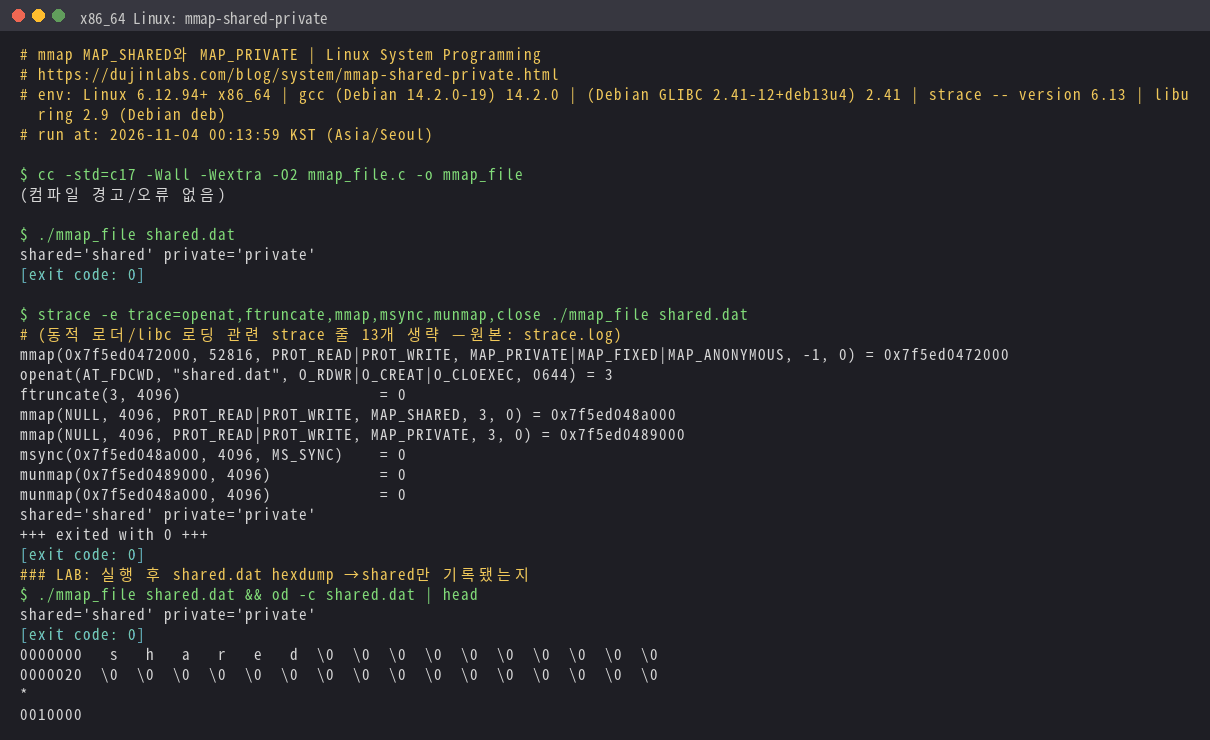
ARM64 execution result
The example was also run in an ARM64 emulator (QEMU, Cortex-A53).

Output as text
This image displays the saved execution log.
shared='shared' private='private'
file bytes:  73 68 61 72 65 64 00
Verification harness exit status: 0
Execution environment
The same C example was cross-compiled for ARM64 and executed on 2026-11-04 in QEMU virt with an emulated Cortex-A53 (TCG, 2 vCPUs, 512 MiB). The guest ran Linux 6.18.58-0-virt, not the article baseline 6.18.37. GCC 15.2.0 and glibc 2.43 were used with static linking; the guest shell and utilities came from Alpine 3.23.7.
The guest ran as root, used loopback only, and had no host disk mounts. This checks the example's observed behavior, not physical hardware timing or every kernel-internal path.
The source above is unchanged. Cross-compiled on the x86_64 host and executed inside the ARM64 guest; static linking was added for the isolated guest. UAPI build headers were 7.0.0, which does not change the running kernel version.
aarch64-linux-gnu-gcc-15 -static -std=c17 -Wall -Wextra -O2 mmap_file.c -o mmap_file

/examples/mmap_file shared.dat
printf 'file bytes: '
head -c 7 shared.dat | od -An -tx1
Commands and captured output · Environment and hashes · Full guest boot and run log
CODE NOTES
Code notes
ftruncate(fd, page)Ensures the file is long enough before mapping it. Accessing a page beyond EOF can generate SIGBUS.
MAP_SHARED, fd, 0Attaches the first page's page-cache backing as a shared mapping. A write is visible to another mapping of the same inode page.
MAP_PRIVATE, fd, 0Reads may use the file page, but a write fault branches to a private anonymous copy.
msync(sharedRequests completion of writeback for the shared dirty range. This does not automatically guarantee directory-entry durability or protection against storage-device power loss.
memcpy(privateOnly the private mapping changes; the string 'private' is not written to the file or the shared mapping.
DETAILS
Detailed behavior
Match file size to mapping size
Although mmap can create a page-granular range, it does not create valid data beyond file EOF. Bytes after EOF in the final partial page may read as zero, but accessing the next page is subject to SIGBUS.
If another process truncates the file, a process with an existing mapping can also receive SIGBUS on a later access.
Separate visibility from synchronization
On a cache-coherent system, another process can see a CPU store to a MAP_SHARED page, but data-structure consistency is not guaranteed. A protocol using atomics, mutexes, sequence counters, or similar mechanisms is required.
msync is not a thread memory-ordering primitive.
mmap I/O still pays page-fault and writeback costs
Reducing read/write syscall count does not remove first-access faults, dirty throttling, reclaim, or filesystem writeback. Measure latency through faults and storage interactions, not syscall count alone.
It may benefit random access and zero-copy parsing, but introduces costs for handling truncate, SIGBUS, and address-space pressure.
DRIVER MAPPING
What does a device-file mmap expose?
The preceding example compares page-cache sharing and COW for a regular file. For a device file, the driver's mmap method receives a VMA and decides which resource to expose. Requesting MAP_SHARED does not make an arbitrary kernel pointer safe to map into userspace.
The Linux 6.18 memory-management API distinguishes remap_pfn_range(), which takes a physical page-frame number (PFN), from vm_iomap_memory(), which takes a physical I/O memory range. remap_vmalloc_range() validates the vmalloc area and mapping size. These paths are not interchangeable: the address type and backing resource matter.
The driver must check length and page offset, the permitted resource range, protection and cache attributes, and a mapping lifetime that may extend beyond device removal. These are device-specific design constraints, not a universal recipe based on old SetPageReserved() examples or conversion of arbitrary kmalloc pointers.
OBJECTS
Objects and lifetimes
| Object | Creation and release | Values to inspect |
|---|---|---|
file-backed VMA | Attached to the inode address_space by mmap and retained until munmap | vm_pgoff, shared/private flag |
page cache folio | Created by file read/fault and passes through dirty/writeback/reclaim | index, dirty, writeback |
private COW page | Created on a MAP_PRIVATE write fault and belongs only to the process mm | anonymous, dirty, RSS |
FAILURE PATH
Failure conditions and common misconceptions
| Observed symptom | Likely causes | How to verify |
|---|---|---|
| SIGBUS | The file is truncated while mapped, or access goes beyond EOF | Inspect si_addr and the current file size |
| Private changes are absent from the file | Normal COW behavior of MAP_PRIVATE | smaps Anonymous/Private_Dirty |
| msync returns EINVAL | The address/range is not page-aligned, or the flags are invalid | Check mapping boundaries and page size |
LAB
Verify it yourself
- After the program runs, hexdump shared.dat and verify that only the shared change was recorded.
- Have another process map the file with MAP_SHARED and distinguish visibility before and after msync from persistence to storage.
- Have another process call ftruncate(0) while the mapping exists, then inspect the SIGBUS handler and the limits of safe recovery.
./mmap_file shared.datstrace -e trace=openat,ftruncate,mmap,msync,munmap,close ./mmap_file shared.datPRIMARY REFERENCES