QUESTION
Can a submitted buffer be reused as soon as io_uring_enter returns?
io_uring setup creates submission and completion ring memory shared by the kernel and userspace. Userspace fills an SQE, publishes the tail, and notifies the kernel with enter; after the kernel request executes, the kernel writes a CQE.
A submit syscall returning does not mean the operation is complete. The operation may refer to a user buffer and file until its CQE is consumed, so track per-request ownership and cancellation results.
STRUCTURE
Structure diagram
Submission Queue
Kernel in-flight
Completion Queue
An SQE slot can be reused after the kernel consumes it, but the user buffer must remain valid until CQE completion. The two lifetimes differ.
CALL PATH
Call path
Draw the SQE-slot lifetime, request lifetime, user-buffer lifetime, and CQE lifetime on one overlapping timeline. Slot reuse and buffer reuse have different completion conditions.
This diagram is not for memorizing function names. Follow which return value, file descriptor, memory mapping, or wait queue is passed to the next stage.
SOURCE COORDINATES
Linux 6.18.37 LTS source locations
Go beyond the glibc function to the files where the syscall implementation meets kernel objects. Each link points to the original file at the same tag.
| File | Function / structure | What to inspect |
|---|---|---|
| io_uring/io_uring.c | io_uring_setup(), io_uring_enter() | Create ring context and enter submission/completion paths |
| io_uring/io_uring.c | io_submit_sqes(), io_init_req() | Convert an SQE into a kernel request |
| io_uring/io_uring.c | io_req_complete_post(), io_cqring_event_overflow() | Publish a CQE and handle overflow |
COMPLETE PROGRAM
Complete runnable example
The code below is not pseudocode with explanatory lines omitted. It is a minimal example that can be built and run as a file.
cc -std=c17 -Wall -Wextra -O2 uring_read.c -luring -o uring_read01#define _DEFAULT_SOURCE
02#include <fcntl.h>
03#include <liburing.h>
04#include <stdio.h>
05#include <string.h>
06#include <unistd.h>
07
08int main(int argc, char **argv)
09{
10 if (argc != 2)
11 return 2;
12 int fd = open(argv[1], O_RDONLY | O_CLOEXEC);
13 struct io_uring ring;
14 if (fd < 0 || io_uring_queue_init(8, &ring, 0) < 0)
15 return 1;
16
17 char buffer[256];
18 struct io_uring_sqe *sqe = io_uring_get_sqe(&ring);
19 io_uring_prep_read(sqe, fd, buffer, sizeof(buffer), 0);
20 io_uring_sqe_set_data64(sqe, 0x1001);
21 if (io_uring_submit(&ring) < 0)
22 return 1;
23
24 struct io_uring_cqe *cqe;
25 if (io_uring_wait_cqe(&ring, &cqe) < 0)
26 return 1;
27 int result = cqe->res;
28 if (result > 0)
29 write(STDOUT_FILENO, buffer, (size_t)result);
30 else if (result < 0)
31 fprintf(stderr, "read: %s\n", strerror(-result));
32 io_uring_cqe_seen(&ring, cqe);
33 io_uring_queue_exit(&ring);
34 close(fd);
35 return result < 0;
36}RUN RESULT
Run results
The example was run on x86_64 Linux.
Execution environment
Built and run on 2026-11-04 on x86_64 Debian (Linux 6.12.94, gcc 14.2.0, glibc 2.41, -std=c17). This differs from the article baseline (ARM64, Linux 6.18.37 LTS), so PIDs, inodes, and addresses differ from run to run.
Before the fix, the code failed to compile under -std=c17 with 19 errors because sigset_t used by liburing.h was undeclared. The code above adds #define _DEFAULT_SOURCE as its first line; it builds without warnings and reads /etc/hostname.
$ cc -std=c17 -Wall -Wextra -O2 uring_read.c -luring -o uring_read   # before the fix
/usr/include/liburing.h:176:24: error: unknown type name ‘sigset_t’; did you mean ‘size_t’?
$ ./uring_read /etc/hostname   # after adding #define _DEFAULT_SOURCE
host
[exit code: 0]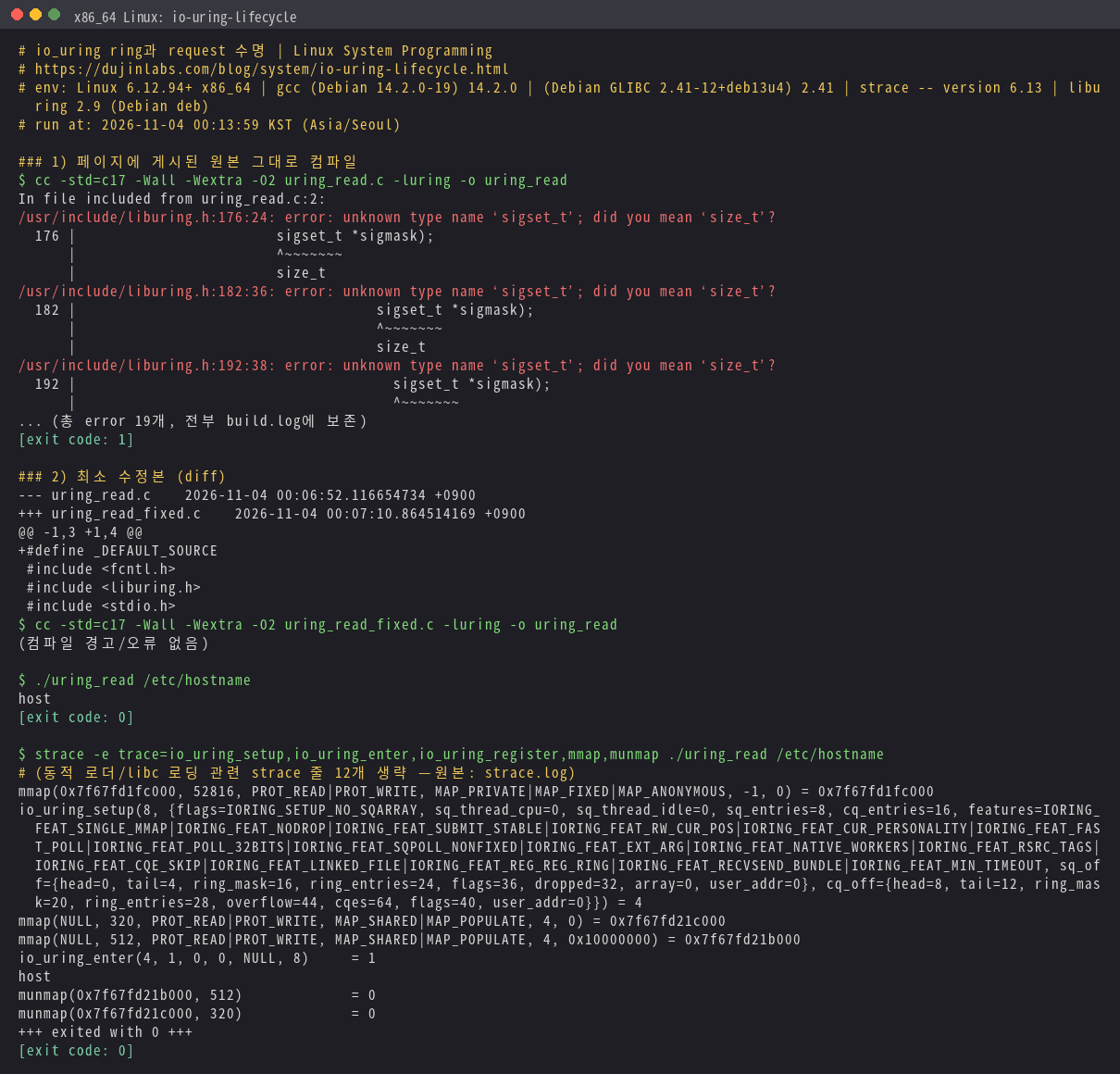
ARM64 execution result
The example was also run in an ARM64 emulator (QEMU, Cortex-A53).
This example additionally used liburing 2.9.

Output as text
This image displays the saved execution log.
arm64-qemu
Verification harness exit status: 0
Execution environment
The same C example was cross-compiled for ARM64 and executed on 2026-11-04 in QEMU virt with an emulated Cortex-A53 (TCG, 2 vCPUs, 512 MiB). The guest ran Linux 6.18.58-0-virt, not the article baseline 6.18.37. GCC 15.2.0 and glibc 2.43 were used with static linking; the guest shell and utilities came from Alpine 3.23.7.
The guest ran as root, used loopback only, and had no host disk mounts. This checks the example's observed behavior, not physical hardware timing or every kernel-internal path.
The source above is unchanged. Cross-compiled on the x86_64 host and executed inside the ARM64 guest; static linking was added for the isolated guest. UAPI build headers were 7.0.0, which does not change the running kernel version.
aarch64-linux-gnu-gcc-15 -static -std=c17 -Wall -Wextra -O2 uring_read.c -luring -o uring_read

/examples/uring_read /etc/hostname
Commands and captured output · Environment and hashes · Full guest boot and run log
CODE NOTES
Code notes
io_uring_queue_init(8Prepares 8-entry SQ/CQ rings, a ring fd, and shared mappings. Inspect setup results for the actual CQ size and features.
char buffer[256]The stack frame and buffer must remain valid until read completion. Returning from the function or reusing them for another request first creates a data race.
io_uring_sqe_set_data64Stores an opaque key that connects the completion to an application request object. Storing only an fd number does not solve reuse.
int result = cqe->resA CQE result is not -1/errno like libc; it is either a successful byte count or negative errno. Pass -result to strerror.
io_uring_cqe_seenAdvances the CQ head, returning that completion slot to the ring. Copy the result and user_data first.
DETAILS
Detailed behavior
Asynchrony depends on opcode and file type
Not every operation always runs on a separate worker or hardware-async path. Inline completion, task work, and io-wq offload can be mixed.
Measure completion latency, worker saturation, and context switches rather than only syscall reduction.
Registered resources change pinning costs
Fixed files and registered buffers can reduce per-request fd lookup and pinning, but extend registration-table and page-pin lifetimes. Account for in-flight requests during update/unregister.
Long-term pinned pages can affect reclaim and migration.
Confirm cancellation through completions too
A successful cancel SQE means the target operation was found and the cancellation request applied; handle ordering of both the target CQE and cancel CQE. A request that already completed can produce a result such as ENOENT.
For linked timeouts and multishot operations, check flags that allow one user_data to produce several CQEs.
OBJECTS
Objects and lifetimes
| Object | Creation and release | Values to inspect |
|---|---|---|
io_ring_ctx | Created by queue_init/setup and released by queue_exit/ring-fd close | SQ/CQ, task refs, worker |
SQE/io_kiocb | Begins in a written SQ slot, becomes a kernel request, and remains in flight until completion | opcode, user_data, buffer/fd refs |
CQE | Created when completion is published and returned to the ring by cqe_seen | res, flags, user_data |
FAILURE PATH
Failure conditions and common misconceptions
| Observed symptom | Likely causes | How to verify |
|---|---|---|
| Buffer contents are corrupted | The buffer was reused or its stack frame returned before completion | Inspect the request owner and CQE timeline |
| CQ overflow/stall | Completions are not consumed fast enough | Inspect CQ depth, the overflow flag, and seen calls |
| Errors are interpreted incorrectly | cqe->res was handled like errno | Apply the negative-errno rule |
LAB
Verify it yourself
- Submit reads at several offsets and use user_data to record that completion order can differ from submission order.
- Compare syscalls, throughput, tail latency, and pinned memory before and after registering files/buffers.
- Add a linked timeout and async cancel, then tabulate combinations of target CQEs with cancel/timeout CQEs.
./uring_read /etc/hostnamestrace -e trace=io_uring_setup,io_uring_enter,io_uring_register,mmap,munmap ./uring_read /etc/hostnamePRIMARY REFERENCES