QUESTION
Does execve create a new process, or change the current one?
execve does not create a new PID. The calling task receives a new mm, code, stack, and credentials and continues under the same PID. The largest difference from an ordinary function is that successful execution never returns to the old code.
Not all state disappears. Fds without close-on-exec, the current working directory, umask, some signal-mask state, and resource limits remain, while caught signal dispositions and address mappings are reset.
STRUCTURE
Structure diagram
before execve
- PID 4120
- multiple threads
- old text/data/heap/stack
- fd 0,1,2,7
- caught signal handlers
retain/recompute
- retain PID·cwd·umask
- apply FD_CLOEXEC
- recompute credentials
- retain resource limits
after execve
- PID 4120
- one calling thread
- new PT_LOAD + stack
- fd 0,1,2
- caught handler reset
execve does not add a new process. It preserves parts of process identity and replaces the userspace image according to the new ELF.
CALL PATH
Call path
View the transition in terms of process identity and process image. The PID remains, but every userspace pointer and the thread configuration now belongs to the new image.
This diagram is not for memorizing function names. Follow which return value, file descriptor, memory mapping, or wait queue is passed to the next stage.
SOURCE COORDINATES
Linux 6.18.37 LTS source locations
Go beyond the glibc function to the files where the syscall implementation meets kernel objects. Each link points to the original file at the same tag.
| File | Function / structure | What to inspect |
|---|---|---|
| fs/exec.c | do_execveat_common(), bprm_execve() | Copy argv/envp and invoke the binary handler |
| fs/exec.c | begin_new_exec(), setup_new_exec() | The irreversible region after the old mm is discarded |
| fs/binfmt_elf.c | load_elf_binary() | Create ELF segments and the initial stack |
COMPLETE PROGRAM
Complete runnable example
The code below is not pseudocode with explanatory lines omitted. It is a minimal example that can be built and run as a file.
cc -std=c17 -Wall -Wextra -O2 exec_replace.c -o exec_replace01#define _GNU_SOURCE
02#include <errno.h>
03#include <fcntl.h>
04#include <stdio.h>
05#include <stdlib.h>
06#include <unistd.h>
07
08extern char **environ;
09
10int main(void)
11{
12 int fd = open("exec.log", O_WRONLY | O_CREAT | O_TRUNC | O_CLOEXEC, 0644);
13 if (fd < 0) {
14 perror("open");
15 return 1;
16 }
17 dprintf(fd, "before exec pid=%ld\n", (long)getpid());
18
19 char *const argv[] = { "sh", "-c",
20 "printf 'after exec pid=%s\n' $$; ls -l /proc/$$/fd", NULL };
21 execve("/bin/sh", argv, environ);
22
23 int saved = errno;
24 dprintf(STDERR_FILENO, "execve failed: %d\n", saved);
25 close(fd);
26 return 1;
27}RUN RESULT
Run results
The example was run on x86_64 Linux.
Execution environment
On 2026-11-04 the program above was built and run unmodified on x86_64 Debian (Linux 6.12.94, gcc 14.2.0, glibc 2.41, -std=c17). This differs from the article baseline (ARM64, Linux 6.18.37 LTS), so PIDs, inodes, and addresses differ from run to run.
The PID is unchanged after exec, and the exec.log descriptor opened with O_CLOEXEC is absent from the new shell's /proc/PID/fd. In the lab, removing O_CLOEXEC made 3 -> .../exec.log appear as an inherited descriptor.
$ ./exec_replace
after exec pid=194954
total 0
lr-x------ 1 user user 64 Nov  4 00:09 0 -> /dev/null
l-wx------ 1 user user 64 Nov  4 00:09 1 -> /path/to/execve-process-replacement/run.log
l-wx------ 1 user user 64 Nov  4 00:09 2 -> /path/to/execve-process-replacement/run.log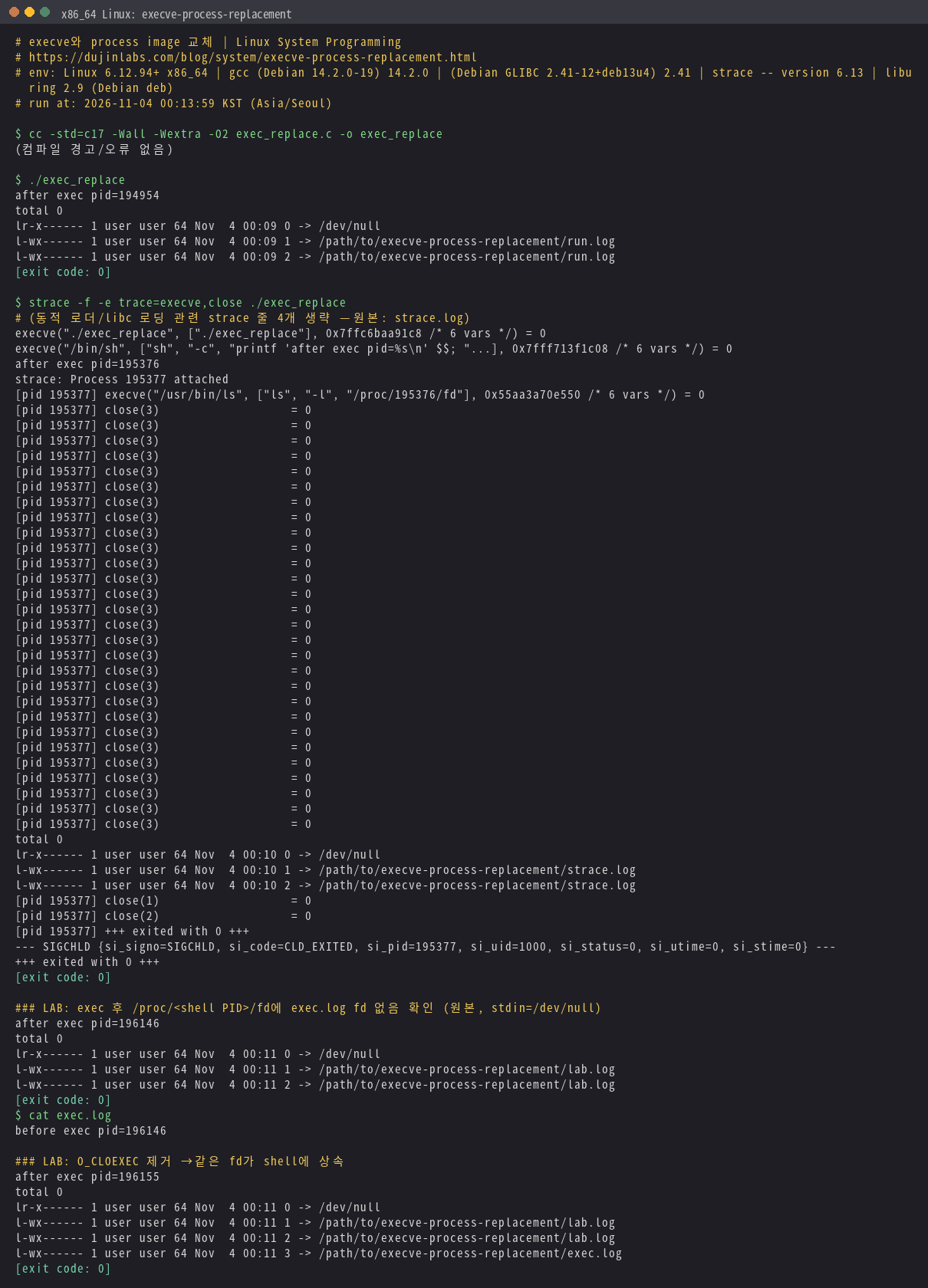
ARM64 execution result
The example was also run in an ARM64 emulator (QEMU, Cortex-A53).
BusyBox ls reported that /proc/PID/fd/3 could not be read because the entry no longer existed; the command still exited with status 0. The PID stayed the same across execve, and exec.log was not present in the listed descriptors. Both the warning and command status are kept below.
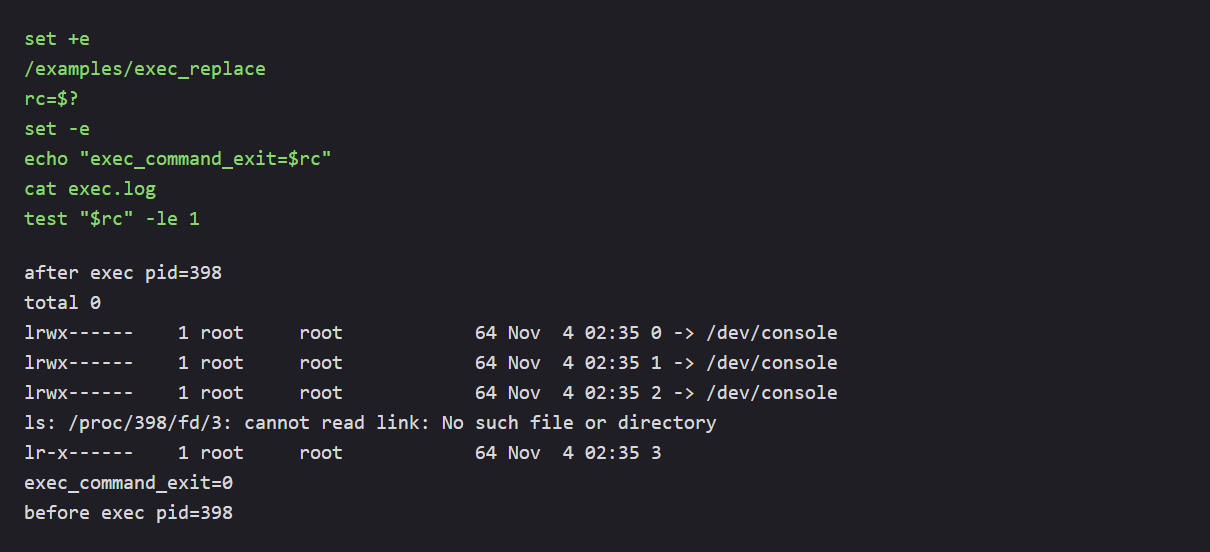
Output as text
This image displays the saved execution log.
after exec pid=398
total 0
lrwx------    1 root     root            64 Nov  4 02:35 0 -> /dev/console
lrwx------    1 root     root            64 Nov  4 02:35 1 -> /dev/console
lrwx------    1 root     root            64 Nov  4 02:35 2 -> /dev/console
ls: /proc/398/fd/3: cannot read link: No such file or directory
lr-x------    1 root     root            64 Nov  4 02:35 3
exec_command_exit=0
before exec pid=398
Verification harness exit status: 0
Execution environment
The same C example was cross-compiled for ARM64 and executed on 2026-11-04 in QEMU virt with an emulated Cortex-A53 (TCG, 2 vCPUs, 512 MiB). The guest ran Linux 6.18.58-0-virt, not the article baseline 6.18.37. GCC 15.2.0 and glibc 2.43 were used with static linking; the guest shell and utilities came from Alpine 3.23.7.
The guest ran as root, used loopback only, and had no host disk mounts. This checks the example's observed behavior, not physical hardware timing or every kernel-internal path.
The source above is unchanged. Cross-compiled on the x86_64 host and executed inside the ARM64 guest; static linking was added for the isolated guest. UAPI build headers were 7.0.0, which does not change the running kernel version.
aarch64-linux-gnu-gcc-15 -static -std=c17 -Wall -Wextra -O2 exec_replace.c -o exec_replace

set +e
/examples/exec_replace
rc=$?
set -e
echo "exec_command_exit=$rc"
cat exec.log
test "$rc" -le 1
Commands and captured output · Environment and hashes · Full guest boot and run log
CODE NOTES
Code notes
O_CLOEXECCombines open and FD_CLOEXEC in one syscall, eliminating the race in which another thread forks or execs between them and leaks the fd.
dprintf(fdThe data written to the file before exec remains, but O_CLOEXEC makes the slot appear closed in the new image's fd table.
char *const argv[]By convention, argv[0] is the program name, and the array must end with a NULL pointer. The kernel limits both the strings and the number of pointers.
execve("/bin/sh"On success, the following line is never executed. A new userspace flow starts at /bin/sh's ELF entry.
int saved = errnoSaves errno immediately after failure, preserving the original reason before dprintf or close can change it.
DETAILS
Detailed behavior
Design fd inheritance as an allowlist
By default, fds survive exec. Use the CLOEXEC variant of every creation syscall, then place only explicitly passed fds at standard or agreed numbers with dup2/dup3 during child setup.
When cleaning up a large fd table, close_range() has fewer races than walking /proc/self/fd.
Credential changes occur together with binary metadata
The setuid/setgid bits, file capabilities, no_new_privs, a nosuid mount, and ptrace state all participate in computing the new effective credentials. Clearing environment variables alone does not complete a privilege boundary.
In secure-execution mode, the dynamic linker restricts environment variables such as LD_PRELOAD.
Separate the fallible region from the unrecoverable region
The kernel validates as much of the binary as possible before discarding the old mm. Even so, a fatal error after replacement begins cannot return to the original image and may terminate the process with a signal.
In production, the parent commonly checks whether child exec succeeded with a CLOEXEC pipe. On success the pipe's write end closes automatically; on failure the child writes errno.
OBJECTS
Objects and lifetimes
| Object | Creation and release | Values to inspect |
|---|---|---|
linux_binprm | Exists from exec preparation until the binary handler completes | file, cred, argc/envc |
fd table | Remains attached to the process, but CLOEXEC slots close at exec commit | close_on_exec bitmap |
mm_struct | The mm for the new image is installed and the old mm reference is released | VMA, arg_start/end, exe_file |
FAILURE PATH
Failure conditions and common misconceptions
| Observed symptom | Likely causes | How to verify |
|---|---|---|
| execve returns ENOENT | The binary or PT_INTERP is absent | Check readelf -l and the pathname |
| EACCES | directory search permission, noexec mount, file mode | Inspect namei -l and findmnt options |
| The child retains an unintended fd | Missing CLOEXEC or an open/fcntl race | Inspect /proc/PID/fd and strace -f |
LAB
Verify it yourself
- After execution, verify that exec.log is absent from the fd list in /proc/<new-shell-PID>/fd.
- Remove O_CLOEXEC and compare how the same fd is inherited by the shell.
- Create a dedicated pipe and implement a handshake in which the child sends the errno from a failed exec to the parent.
./exec_replacestrace -f -e trace=execve,close ./exec_replacePRIMARY REFERENCES