Part 1
요약·해설
단순 sensor access와 다른 Sensing Subsystem의 역할, physical·virtual sensor topology, CHRE·HID 연계, instance handle, microsecond batch timestamp, Q-format과 전체 API를 설명합니다.
Physical · virtual
Application · sensor
Batch · timestamp · Q31
Part 2
접을 수 있는 영어 원문 전체
영어 원문 전체 펼치기
828AB20B548EB6C1675B480393EEF3A30F0B2BBDDD8FE49A64FE6744CE1D7941
.. _sensing:

Sensing Subsystem
########################

.. contents::
    :local:
    :depth: 2

Overview
********

Sensing Subsystem is a high level sensor framework inside the OS user
space service layer. It is a framework focused on sensor fusion, client
arbitration, sampling, timing, scheduling and sensor based power management.

Key concepts in Sensing Subsystem include physical sensor and virtual sensor objects,
and a scheduling framework over sensor object relationships.
Physical sensors do not depend on any other sensor objects for input, and
will directly interact with existing zephyr sensor device drivers.
Virtual sensors rely on other sensor objects (physical or virtual) as
report inputs.

The sensing subsystem relies on Zephyr sensor device APIs (existing version or update in future)
to leverage Zephyr's large library of sensor device drivers (100+).

Use of the sensing subsystem is optional. Applications that only need to access simple sensors
devices can use the Zephyr :ref:`sensor` API directly.

Since the sensing subsystem is separated from device driver layer or
kernel space and could support various customizations and sensor
algorithms in user space with virtual sensor concepts. The existing
sensor device driver can focus on low layer device side works, can keep
simple as much as possible, just provide device HW abstraction and
operations etc. This is very good for system stability.

The sensing subsystem is decoupled with any sensor expose/transfer
protocols, the target is to support various up-layer frameworks and
Applications with different sensor expose/transfer protocols,
such as `CHRE <https://github.com/zephyrproject-rtos/chre>`_, HID sensors Applications,
MQTT sensor Applications according different products requirements. Or even support multiple
Applications with different up-layer sensor protocols at the same time
with it's multiple clients support design.

Sensing subsystem can help build a unified Zephyr sensing architecture for
cross host OSes support and as well as IoT sensor solutions.

The diagram below illustrates how the Sensing Subsystem integrates with up-layer frameworks.

.. image:: ../../../../services/sensing/images/sensing_solution.png
   :align: center
   :alt: Unified Zephyr sensing architecture.

Configurability
***************

* Reusable and configurable standalone subsystem.
* Based on Zephyr existing low-level Sensor API (reuse 100+ existing sensor device drivers)
* Provide Zephyr high-level Sensing Subsystem API for Applications.
* Separate option CHRE Sensor PAL Implementation module to support CHRE.
* Decoupled with any host link protocols, it's Zephyr Application's role to handle different
  protocols (MQTT, HID or Private, all configurable)

Main Features
*************

* Scope
    * Focus on framework for sensor fusion, multiple clients, arbitration, data sampling, timing
      management and scheduling.

* Sensor Abstraction
    * ``Physical sensor``: interacts with Zephyr sensor device drivers, focus on data collecting.
    * ``Virtual sensor``: relies on other sensor(s), ``physical`` or ``virtual``, focus on
      data fusion.

* Data Driven Model
    * ``Polling mode``: periodical sampling rate
    * ``Interrupt mode``: data ready, threshold interrupt etc.

* Scheduling
    * single thread main loop for all sensor objects sampling and process.

* Buffer Mode for Batching

* Configurable Via Device Tree


Below diagram shows the API position and scope:

.. image:: ../../../../services/sensing/images/sensing_api_org.png
   :align: center
   :alt: Sensing subsystem API organization.

``Sensing Subsystem API`` is for Applications.
``Sensing Sensor API`` is for development ``sensors``.


Major Flows
***********

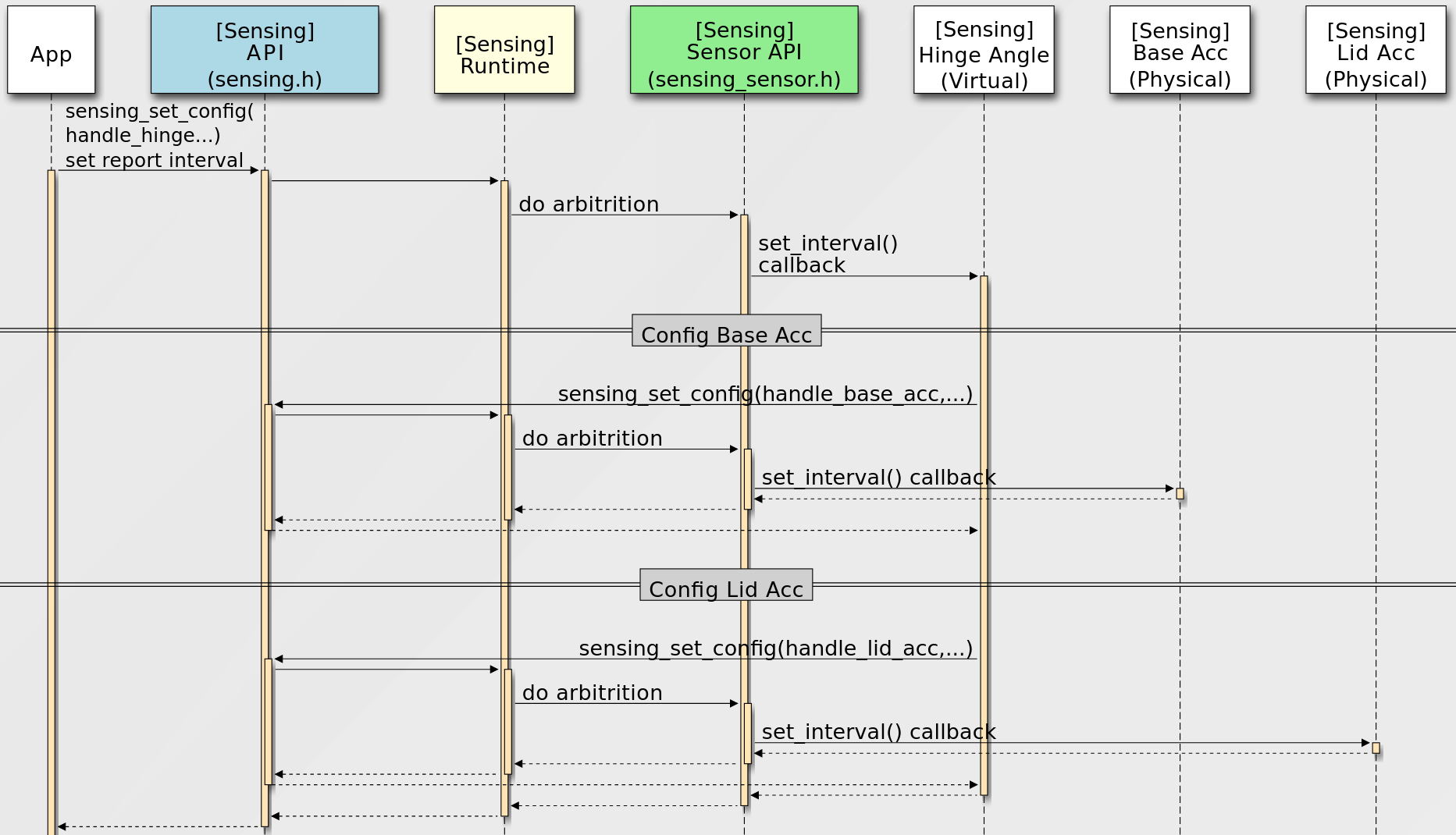
* Sensor Configuration Flow

.. image:: ../../../../services/sensing/images/sensor_config_flow.png
   :align: center
   :alt: Sensor Configuration Flow (App set report interval to hinge angel sensor example).

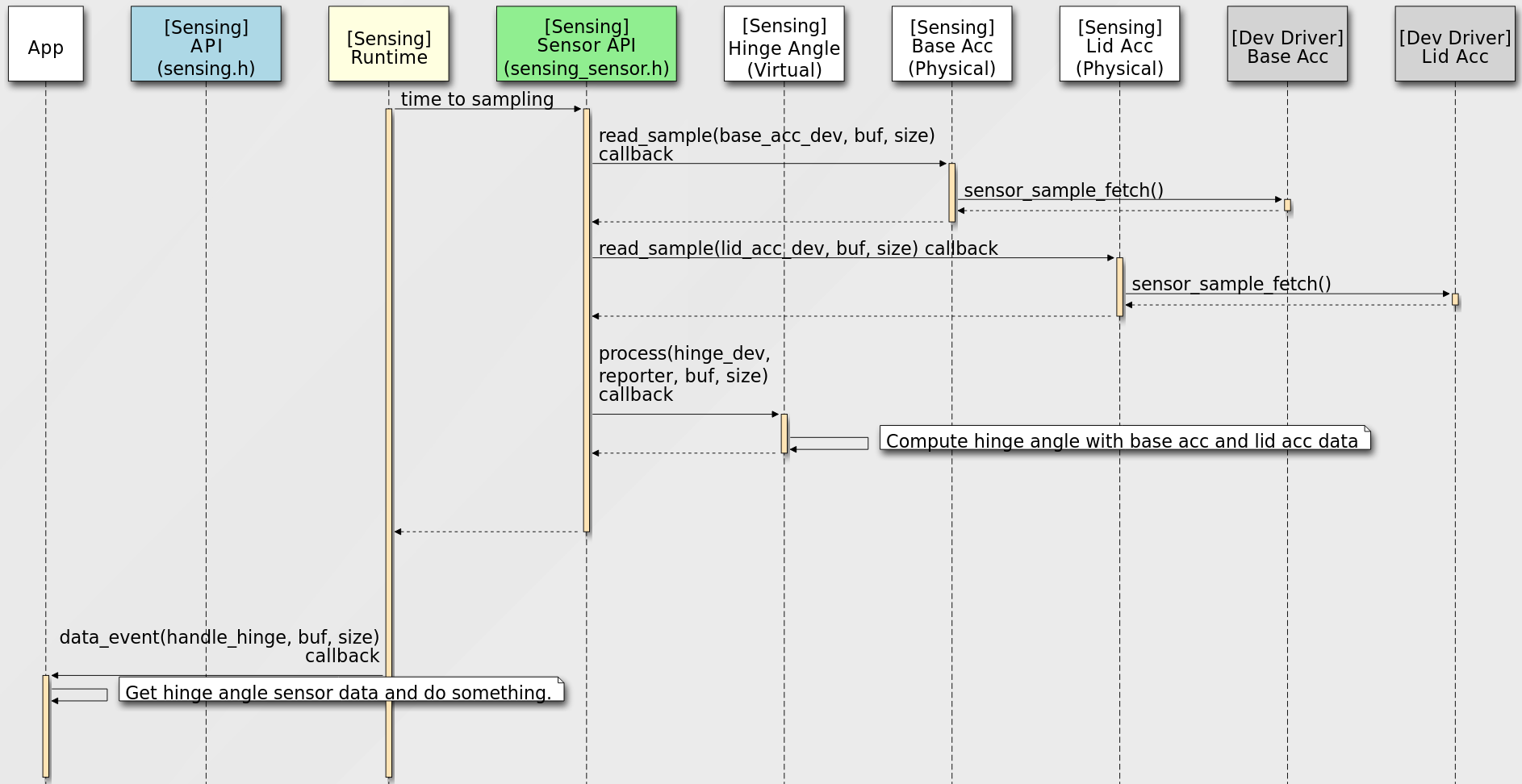
* Sensor Data Flow

.. image:: ../../../../services/sensing/images/sensor_data_flow.png
   :align: center
   :alt: Sensor Data Flow (App receive hinge angel data through data event callback example).

Sensor Types And Instance
*************************

The ``Sensing Subsystem`` supports multiple instances of the same sensor type,
there're two methods for Applications to identify and open an unique sensor instance:

* Enumerate all sensor instances

  :c:func:`sensing_get_sensors` returns all current board configuration supported sensor instances'
  information in a :c:struct:`sensing_sensor_info` pointer array .

  Then Applications can use :c:func:`sensing_open_sensor` to
  open specific sensor instance for future accessing, configuration and receive sensor data etc.

  This method is suitable for supporting some up-layer frameworks like ``CHRE``, ``HID`` which need
  to dynamically enumerate the underlying platform's sensor instances.

* Open the sensor instance by devicetree node directly

  Applications can use :c:func:`sensing_open_sensor_by_dt` to open a sensor instance directly with
  sensor devicetree node identifier.

  For example:

.. code-block:: c

   sensing_open_sensor_by_dt(DEVICE_DT_GET(DT_NODELABEL(base_accel)), cb_list, handle);
   sensing_open_sensor_by_dt(DEVICE_DT_GET(DT_CHOSEN(zephyr_sensing_base_accel)), cb_list, handle);

This method is useful and easy use for some simple Application which just want to access specific
sensor(s).


``Sensor type`` follows the
`HID standard sensor types definition <https://usb.org/sites/default/files/hutrr39b_0.pdf>`_.

See :zephyr_file:`include/zephyr/sensing/sensing_sensor_types.h`

Sensor Instance Handler
***********************

Clients using a :c:type:`sensing_sensor_handle_t` type handler to handle a opened sensor
instance, and all subsequent operations on this sensor instance need use this handler,
such as set configurations, read sensor sample data, etc.

For a sensor instance, could have two kinds of clients:
``Application clients`` and ``Sensor clients``.

``Application clients`` can use :c:func:`sensing_open_sensor` to open a sensor instance
and get it's handler.

For ``Sensor clients``, there is no open API for opening a reporter, because the client-report
relationship is built at the sensor's registration stage with devicetree.

The ``Sensing Subsystem`` will auto open and create ``handlers`` for client sensor
to it's reporter sensors.
``Sensor clients`` can get it's reporters' handlers via :c:func:`sensing_sensor_get_reporters`.

.. image:: ../../../../services/sensing/images/sensor_top.png
   :align: center
   :alt: Sensor Reporting Topology.

.. note::
   Sensors inside the Sensing Subsystem, the reporting relationship between them are all auto
   generated by Sensing Subsystem according devicetree definitions, handlers between client sensor
   and reporter sensors are auto created.
   Application(s) need to call :c:func:`sensing_open_sensor` to explicitly open the sensor instance.

Sensor Sample Value
*******************

* Data Structure

  Each sensor sample value defines as a common ``header`` + ``readings[]`` data structure, like
  :c:struct:`sensing_sensor_value_3d_q31`, :c:struct:`sensing_sensor_value_q31`, and
  :c:struct:`sensing_sensor_value_uint32`.

  The ``header`` definition :c:func:`sensing_sensor_value_header`.


* Time Stamp

  Time stamp unit in sensing subsystem is ``micro seconds``.

  The ``header`` defines a **base_timestamp**, and
  each element in the **readings[]** array defines **timestamp_delta**.

  The **timestamp_delta** is in relation to the previous **readings** (or the **base_timestamp**)

  For example:

  * timestamp of ``readings[0]`` is ``header.base_timestamp`` + ``readings[0].timestamp_delta``.

  * timestamp of ``readings[1]`` is ``timestamp of readings[0]`` + ``readings[1].timestamp_delta``.

  Since timestamp unit is micro seconds,
  the max **timestamp_delta** (``uint32_t``) is ``4295`` seconds.

  If a sensor has batched data where two consecutive readings differ by more than ``4295`` seconds,
  the sensing subsystem runtime will split them across multiple instances of the readings structure,
  and send multiple events.

  This concept is referred from `CHRE Sensor API <https://github.com/zephyrproject-rtos/
  chre/blob/zephyr/chre_api/include/chre_api/chre/sensor_types.h>`_.

* Data Format

  ``Sensing Subsystem`` uses per sensor type defined data format structure,
  and support ``Q Format`` defined in :zephyr_file:`include/zephyr/dsp/types.h`
  for ``zdsp`` lib support.

  For example :c:struct:`sensing_sensor_value_3d_q31` can be used by 3D IMU sensors like
  :c:macro:`SENSING_SENSOR_TYPE_MOTION_ACCELEROMETER_3D`,
  :c:macro:`SENSING_SENSOR_TYPE_MOTION_UNCALIB_ACCELEROMETER_3D`,
  and :c:macro:`SENSING_SENSOR_TYPE_MOTION_GYROMETER_3D`.

  :c:struct:`sensing_sensor_value_uint32` can be used by
  :c:macro:`SENSING_SENSOR_TYPE_LIGHT_AMBIENTLIGHT` sensor,

  and :c:struct:`sensing_sensor_value_q31` can be used by
  :c:macro:`SENSING_SENSOR_TYPE_MOTION_HINGE_ANGLE` sensor

  See :zephyr_file:`include/zephyr/sensing/sensing_datatypes.h`


Device Tree Configuration
*************************

Sensing subsystem using device tree to configuration all sensor instances and their properties,
reporting relationships.

See the example :zephyr_file:`samples/subsys/sensing/simple/boards/native_sim.overlay`

API Reference
*************

.. doxygengroup:: sensing_sensor_types
.. doxygengroup:: sensing_datatypes
.. doxygengroup:: sensing_api
.. doxygengroup:: sensing_sensor
Part 3
한국어 전문 번역
Overview
Sensing Subsystem은 OS user-space service layer에 놓이는 high-level sensor framework입니다. Sensor fusion, client arbitration, sampling, timing, scheduling과 sensor 기반 power management를 다룹니다.
핵심 객체는 physical sensor와 virtual sensor입니다. Physical sensor는 입력을 위해 다른 sensor object에 의존하지 않고 기존 Zephyr sensor driver와 직접 상호작용합니다. Virtual sensor는 physical 또는 다른 virtual sensor의 report를 입력으로 받아 fusion·derived value를 만듭니다. Scheduler는 이 sensor 관계 graph 위에서 실행됩니다.
Subsystem은 Zephyr Sensor API와 100개 이상의 기존 driver를 재사용합니다. 단순 device 한두 개만 읽는 application은 이 subsystem을 쓰지 않고 기존 Sensor API를 직접 사용해도 됩니다.
Driver/kernel layer와 분리돼 user space에서 custom algorithm과 virtual sensor를 확장할 수 있습니다. Driver는 hardware abstraction과 low-level operation에 집중해 단순하게 유지할 수 있고, 이는 system stability에도 유리합니다.
Sensor expose·transfer protocol과도 분리돼 있습니다. CHRE, HID sensor, MQTT 또는 private protocol을 product 요구에 맞춰 application이 선택할 수 있고, multiple-client 설계 덕분에 서로 다른 upper-layer protocol을 동시에 지원할 수도 있습니다. 이로써 host OS를 넘나드는 통합 sensing architecture와 IoT sensor solution을 구성할 수 있습니다.
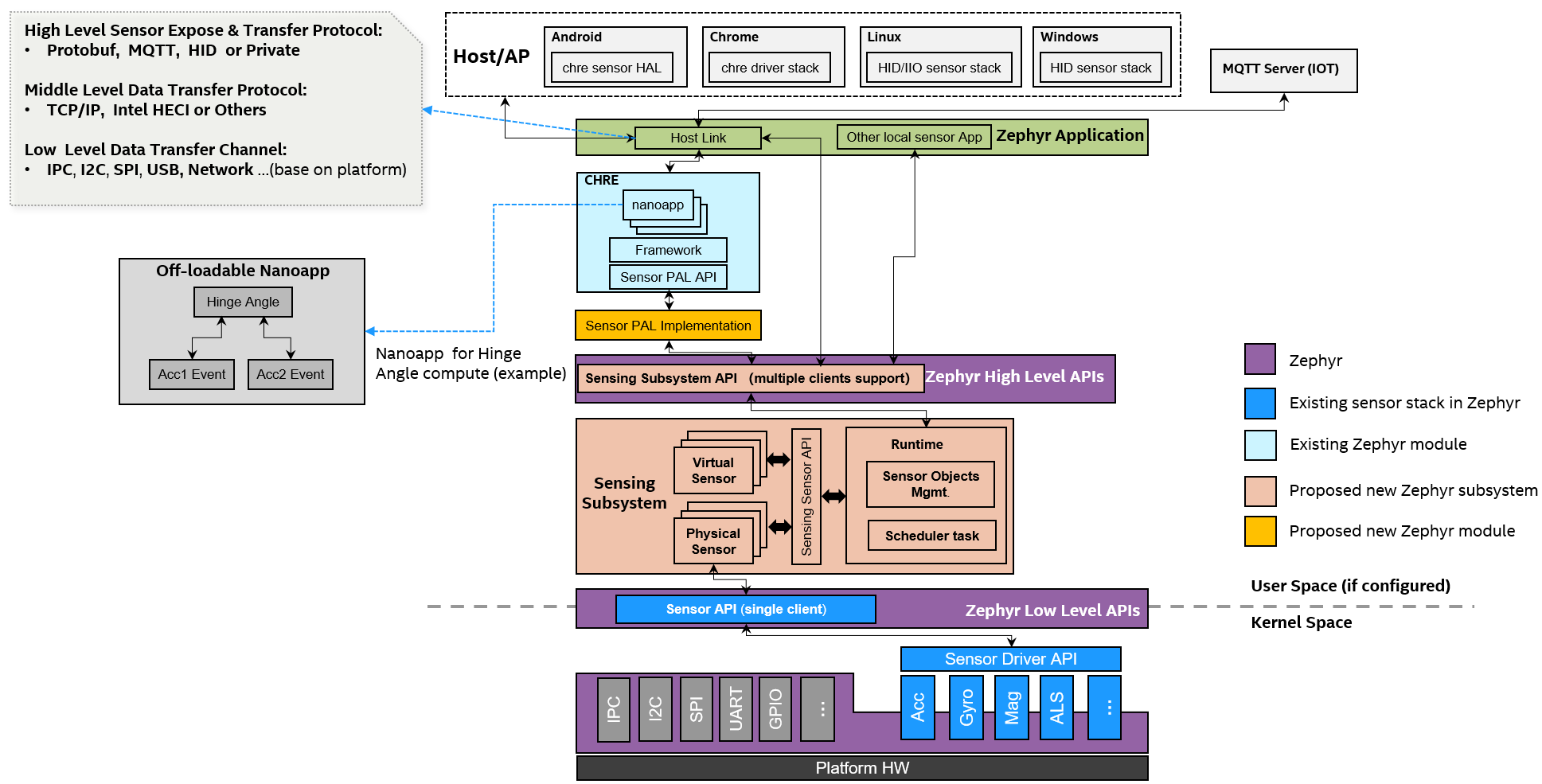
Configurability
- 독립적으로 재사용하고 설정할 수 있는 subsystem입니다.
- 기존 low-level Sensor API와 100개 이상의 driver를 재사용합니다.
- Application에는 high-level Sensing Subsystem API를 제공합니다.
- CHRE 지원은 별도 Sensor PAL implementation module로 선택할 수 있습니다.
- Host link protocol과 분리돼 MQTT, HID, private protocol 처리는 Zephyr application이 담당합니다.
Main Features
- Scope: sensor fusion, multiple clients, arbitration, sampling, timing management와 scheduling.
- Physical sensor: Zephyr sensor driver와 연결해 data collection을 담당.
- Virtual sensor: physical·virtual reporter의 data를 받아 fusion을 담당.
- Data-driven model: periodic polling과 data-ready·threshold interrupt mode.
- Scheduling: 모든 sensor object의 sampling과 processing을 single-thread main loop에서 수행.
- Batching: report latency와 buffer를 이용해 여러 sample을 묶음.
- Configuration: sensor instance와 관계를 Devicetree로 정의.
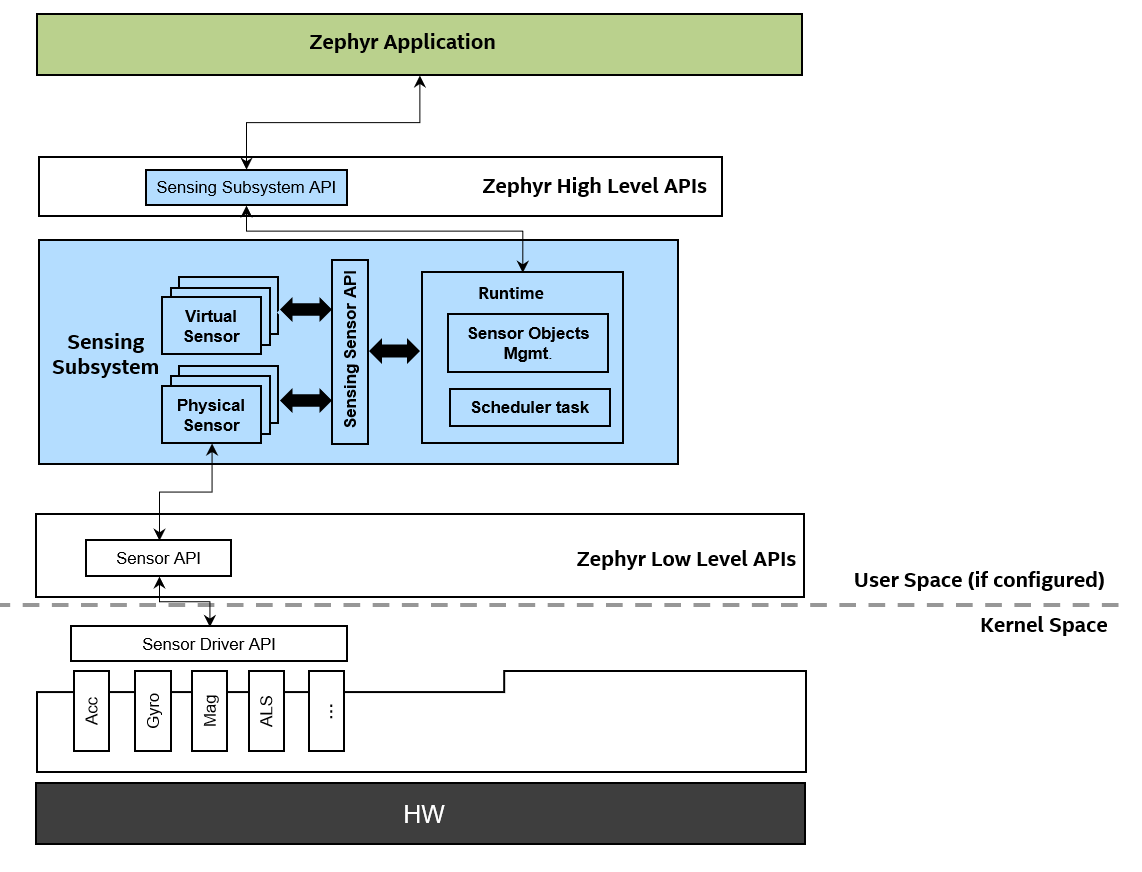
Sensing Subsystem API는 application이 사용하고, Sensing Sensor API는 subsystem 안의 sensor implementation을 개발할 때 사용합니다.
Major Flows
Sensor configuration flow에서는 application이 handle의 report interval 등을 설정하고 subsystem이 client·reporter 관계에 맞춰 실제 sensor와 scheduler를 조정합니다.
Sensor data flow에서는 physical reporter가 sample을 만들고 virtual sensor가 필요하면 fusion한 뒤, application client의 data-event callback으로 결과를 전달합니다.
Sensor Types And Instance
같은 sensor type의 instance를 여러 개 둘 수 있습니다. Application이 고유 instance를 찾아 여는 방법은 두 가지입니다.
- 전체 열거:
sensing_get_sensors()로 board가 지원하는 모든sensing_sensor_info를 얻고,sensing_open_sensor()로 하나를 엽니다. CHRE·HID처럼 platform sensor를 runtime에 열거해야 하는 framework에 적합합니다. - Devicetree 직접 지정:
sensing_open_sensor_by_dt()에 node device를 넘깁니다. 사용할 sensor가 정해진 간단한 application에 적합합니다.
sensing_open_sensor_by_dt(DEVICE_DT_GET(DT_NODELABEL(base_accel)), cb_list, handle);
sensing_open_sensor_by_dt(DEVICE_DT_GET(DT_CHOSEN(zephyr_sensing_base_accel)), cb_list, handle);
Sensor type 값은 HID 표준 sensor-type 정의를 따르며 선언은 include/zephyr/sensing/sensing_sensor_types.h에 있습니다.
Sensor Instance Handler
Client는 열린 instance를 sensing_sensor_handle_t handle로 다룹니다. Configuration 설정, sample 수신과 이후 모든 operation에 이 handle을 사용합니다.
Client에는 application client와 sensor client가 있습니다. Application은 sensing_open_sensor()를 명시적으로 호출해 handle을 받습니다. 반면 virtual sensor 같은 sensor client와 reporter의 관계는 등록 시 Devicetree에서 만들어지므로 별도 open API가 없습니다.
Subsystem은 client sensor가 사용할 reporter handle을 자동으로 만들고 엽니다. Sensor implementation은 sensing_sensor_get_reporters()로 reporter handle을 얻습니다. 즉 sensor 간 topology는 Devicetree로 자동 생성되지만 application은 원하는 instance를 명시적으로 열어야 합니다.
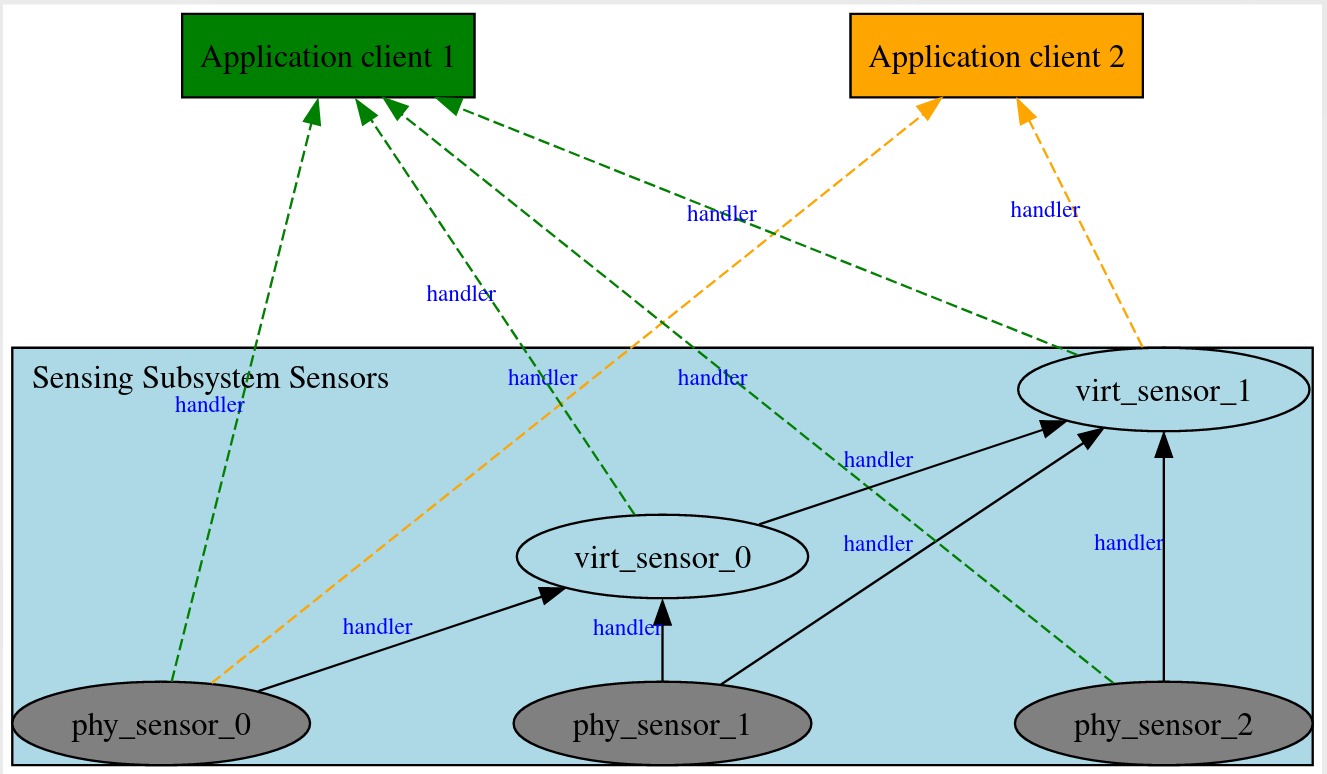
Sensor Sample Value
모든 sample value는 공통 header와 readings[] 배열로 구성됩니다. 예로 3D Q31, scalar Q31, uint32 structure가 있습니다.
Timestamp 단위는 microsecond입니다. Header의 base_timestamp가 기준이고, 각 reading의 timestamp_delta는 이전 reading 또는 첫 element라면 base timestamp에 대한 차이입니다.
readings[0]시각 =header.base_timestamp + readings[0].timestamp_deltareadings[1]시각 =readings[0]시각 +readings[1].timestamp_delta
timestamp_delta는 uint32 microsecond이므로 최댓값은 약 4295초입니다. 연속 reading 간 차이가 이를 넘는 batched data는 runtime이 여러 readings structure로 나눠 여러 event로 전송합니다. 이 모델은 CHRE Sensor API를 참고했습니다.
Data format은 sensor type별 structure를 사용하며 include/zephyr/dsp/types.h의 Q Format을 지원해 zdsp와 연결됩니다. 3D Q31은 accelerometer·uncalibrated accelerometer·gyrometer, uint32는 ambient light, scalar Q31은 hinge angle에 사용할 수 있습니다. 정의는 include/zephyr/sensing/sensing_datatypes.h에 있습니다.
Device Tree Configuration
Sensing Subsystem은 모든 sensor instance, property와 reporting relationship을 Devicetree로 구성합니다. 실제 예는 samples/subsys/sensing/simple/boards/native_sim.overlay에서 확인할 수 있습니다.
API Reference
다음 84개 항목은 공식 sensor types, datatype, application API와 sensor implementation API group을 빠짐없이 옮긴 것입니다.
SENSING_SENSOR_TYPE_LIGHT_AMBIENTLIGHT- HID 정의를 따르는 ambient-light sensor type입니다.
SENSING_SENSOR_TYPE_MOTION_ACCELEROMETER_3D- 보정된 3축 accelerometer sensor type입니다.
SENSING_SENSOR_TYPE_MOTION_GYROMETER_3D- 3축 angular-velocity gyrometer sensor type입니다.
SENSING_SENSOR_TYPE_MOTION_MOTION_DETECTOR- 움직임 발생 여부를 보고하는 motion-detector type입니다.
SENSING_SENSOR_TYPE_OTHER_CUSTOM- 표준 type에 없는 product-specific custom sensor type입니다.
SENSING_SENSOR_TYPE_MOTION_UNCALIB_ACCELEROMETER_3D- 보정되지 않은 3축 accelerometer type입니다.
SENSING_SENSOR_TYPE_MOTION_HINGE_ANGLE- Hinge angle을 보고하는 motion sensor type입니다.
SENSING_SENSOR_TYPE_ALL- 모든 sensing sensor type을 선택할 때 쓰는 값입니다.
sensing_sensor_value_header- Batched sample 묶음의 base timestamp와 reading 수를 담는 공통 header입니다.
sensing_sensor_value_header.base_timestamp- 첫 reading의 기준이 되는 microsecond timestamp입니다.
sensing_sensor_value_header.reading_count- 뒤따르는
readings[]element 수입니다. sensing_sensor_value_3d_q31- 3축 Q31 sample 묶음의 header, shift와 readings를 담습니다.
sensing_sensor_value_3d_q31.header- 3D Q31 sample 묶음의 공통 header입니다.
sensing_sensor_value_3d_q31.shift- Q31 fixed-point 값을 해석할 때 적용하는 binary shift입니다.
sensing_sensor_value_3d_q31.timestamp_delta- 이전 reading 기준 microsecond 시간 차입니다.
sensing_sensor_value_3d_q31.v- 3축 값을 한 배열로 접근하는 표현입니다.
sensing_sensor_value_3d_q31.x- X축 Q31 값입니다.
sensing_sensor_value_3d_q31.y- Y축 Q31 값입니다.
sensing_sensor_value_3d_q31.z- Z축 Q31 값입니다.
sensing_sensor_value_3d_q31.readings- Timestamp delta와 3축 값을 가진 batched reading 배열입니다.
sensing_sensor_value_uint32- Unsigned 32-bit scalar sample 묶음입니다.
sensing_sensor_value_uint32.header- Uint32 sample 묶음의 공통 header입니다.
sensing_sensor_value_uint32.timestamp_delta- 이전 uint32 reading 기준 microsecond 시간 차입니다.
sensing_sensor_value_uint32.v- Unsigned 32-bit sensor reading 값입니다.
sensing_sensor_value_uint32.readings- Timestamp delta와 uint32 값을 가진 batched 배열입니다.
sensing_sensor_value_q31- Q31 scalar sample 묶음입니다.
sensing_sensor_value_q31.header- Q31 scalar sample 묶음의 공통 header입니다.
sensing_sensor_value_q31.shift- Q31 fixed-point scalar의 binary shift입니다.
sensing_sensor_value_q31.timestamp_delta- 이전 Q31 reading 기준 microsecond 시간 차입니다.
sensing_sensor_value_q31.v- Q31 scalar sensor 값입니다.
sensing_sensor_value_q31.readings- Timestamp delta와 Q31 값을 가진 batched 배열입니다.
SENSING_SENSOR_VERSION- Major·minor·hotfix·build를 하나의 sensor version 값으로 구성합니다.
SENSING_SENSOR_FLAG_REPORT_ON_EVENT- Sensor가 data event 때 report하도록 표시합니다.
SENSING_SENSOR_FLAG_REPORT_ON_CHANGE- Sensor value가 바뀐 경우에만 report하도록 표시합니다.
SENSING_SENSITIVITY_INDEX_ALL- 모든 sensitivity field에 configuration을 적용하는 index입니다.
sensing_sensor_handle_t- 열린 sensor instance를 이후 operation에서 식별하는 opaque handle type입니다.
sensing_data_event_t- Sensor data event callback에 전달되는 event type입니다.
sensing_sensor_state- Sensor instance의 runtime 상태 enumeration입니다.
sensing_sensor_state.SENSING_SENSOR_STATE_READY- Sensor가 data를 제공할 준비가 된 상태입니다.
sensing_sensor_state.SENSING_SENSOR_STATE_OFFLINE- Sensor를 현재 사용할 수 없는 상태입니다.
sensing_sensor_attribute- Interval, sensitivity, latency configuration attribute 종류입니다.
sensing_sensor_attribute.SENSING_SENSOR_ATTRIBUTE_INTERVAL- Report 또는 sample interval attribute입니다.
sensing_sensor_attribute.SENSING_SENSOR_ATTRIBUTE_SENSITIVITY- 변화 감지 sensitivity attribute입니다.
sensing_sensor_attribute.SENSING_SENSOR_ATTRIBUTE_LATENCY- Batching에 허용할 report latency attribute입니다.
sensing_sensor_attribute.SENSING_SENSOR_ATTRIBUTE_MAX- 유효 attribute 범위의 끝을 나타내는 sentinel입니다.
sensing_get_sensors- Board configuration에서 사용할 수 있는 모든 sensor instance 정보를 열거합니다.
sensing_open_sensor- 열거한 sensor info로 instance를 열고 application handle을 얻습니다.
sensing_open_sensor_by_dt- Devicetree device node를 지정해 sensor instance를 직접 엽니다.
sensing_close_sensor- Application이 연 sensor handle을 닫고 client resource를 해제합니다.
sensing_set_config- Handle의 interval·sensitivity·latency configuration을 설정합니다.
sensing_get_config- 현재 sensor configuration을 읽습니다.
sensing_get_sensor_info- 열린 handle에 대응하는 immutable sensor information을 얻습니다.
sensing_sensor_version- Packed value와 개별 version field를 함께 제공하는 sensor version union입니다.
sensing_sensor_version.value- 전체 version을 한 번에 비교할 수 있는 packed integer입니다.
sensing_sensor_version.major- 호환성에 큰 영향을 주는 major version입니다.
sensing_sensor_version.minor- 기능 확장을 나타내는 minor version입니다.
sensing_sensor_version.hotfix- 수정 release를 나타내는 hotfix version입니다.
sensing_sensor_version.build- Build revision 값입니다.
sensing_sensor_info- Instance 이름, vendor, model, type과 최소 interval을 기술합니다.
sensing_sensor_info.name- Sensor instance의 system name입니다.
sensing_sensor_info.friendly_name- UI 등에 표시할 사람이 읽기 쉬운 이름입니다.
sensing_sensor_info.vendor- Sensor 또는 algorithm 공급자 이름입니다.
sensing_sensor_info.model- Sensor model 이름입니다.
sensing_sensor_info.type- HID-compatible sensing sensor type입니다.
sensing_sensor_info.minimal_interval- Sensor가 지원하는 가장 짧은 report interval입니다.
sensing_callback_list- Application data callback과 caller context를 묶습니다.
sensing_callback_list.on_data_event- 새 sample 또는 batch가 준비됐을 때 호출할 callback입니다.
sensing_callback_list.context- Callback에 다시 전달할 application context pointer입니다.
sensing_sensor_config- 한 sensor attribute를 설정하거나 읽는 configuration object입니다.
sensing_sensor_config.attri- 대상
sensing_sensor_attribute입니다. sensing_sensor_config.data_field- Sensitivity처럼 여러 field가 있는 data의 대상 index입니다.
sensing_sensor_config.interval- Microsecond 단위 sample/report interval 값입니다.
sensing_sensor_config.sensitivity- Report-on-change에 적용할 sensitivity 값입니다.
sensing_sensor_config.latency- Batching에서 허용하는 최대 report latency입니다.
SENSING_SENSORS_DT_DEFINE- Devicetree node에 기술된 sensing sensor object를 정의합니다.
SENSING_SENSORS_DT_INST_DEFINE- 현재 compatible의 devicetree instance로 sensing sensor를 정의합니다.
sensing_sensor_get_reporters- Virtual/client sensor에 data를 제공하는 reporter handle 배열을 얻습니다.
sensing_sensor_get_reporters_count- 해당 sensor에 연결된 reporter 수를 반환합니다.
sensing_sensor_get_state- Sensor instance의 ready 또는 offline 상태를 읽습니다.
sensing_sensor_register_info- Sensor implementation 등록 때 필요한 flag, sample 크기, sensitivity 수와 version입니다.
sensing_sensor_register_info.flags- Event·change reporting 같은 sensor capability flag입니다.
sensing_sensor_register_info.sample_size- 한 sample value structure의 byte 크기입니다.
sensing_sensor_register_info.sensitivity_count- 지원하는 독립 sensitivity field 수입니다.
sensing_sensor_register_info.version- 등록하는 sensor implementation의 version입니다.
Source
출처
영어 원문에는 문단, 문서 지시문, 표, 코드, 코드 심벌, 경로를 그대로 보존했습니다.